


EXODUS Newsletter #2
- A few words about VIA-STOP
The Institute for the Prevention and Treatment of Violence and the Promotion of Gender Equality “VIA-STOP” was founded in Kavala in 2008 as a Civil Non-Profit Company. Its main objective is the comprehensive prevention, treatment, and response to all forms of violence, regardless of how they appear.
- Bias Indicators (summary)
Bruchmann et al. (2023) suggest that bias indicators influence how people perceive news, signaling whether an article aligns with the reader’s political beliefs. People tend to seek information that confirms their existing views, partly due to their political identity. Research shows that trust in and preference for members of one’s own political group often stem from shared moral values, but dislike toward members of opposing groups may be an even stronger factor (Abramowitz et al., 2018).
Antisemitism, as a long-standing form of hatred, remains a complex issue in Europe. Research shows a gap between the perception of Jewish communities and that of the general public, with Jews considering antisemitism to be widespread, while broader surveys indicate a decline. The media and the internet play a crucial role in shaping these perceptions. Some individuals may not be openly antisemitic but may still hold negative stereotypes that contribute to the discomfort experienced by Jewish people.
The relationship between antisemitism and anti-Israeli views is widely debated, with some scholars arguing that contemporary antisemitism is often expressed as hostility toward Israel (Klug, 2003). Staetsky (2017) introduces the concept of the “elastic view” to explain differences in the perception of antisemitism. Vergani et al. (2021) link different stimuli to different types of antisemitic incidents.
- Understanding and Supporting Victims of Hate Crimes
In a recent presentation, forensic psychologist Eleni Fotou (Institute for the Prevention and Treatment of Violence and the Promotion of Gender Equality) highlighted a particularly important – yet often misunderstood – issue: supporting victims, especially those who have experienced hate crimes.
Hate crimes are unique because they target individuals or groups due to their identity -such as race, religion, gender, disability, or other characteristics. Their impact goes beyond the individual and affects entire communities.
The presentation emphasized that the concept of the “victim” is a social construct, shaped by legal frameworks, policies, and societal perceptions. Special attention was given to antisemitic crimes, where victims are often targeted based on prejudice, stereotypes, and conspiracy theories.
Ms. Fotou underlined the need for holistic support for victims, including:
- Legal and institutional protection mechanisms
- Psychosocial care and community support
- Education and awareness among affected groups
Her key message was clear: meaningful support for victims requires not only empathy but also coordinated action across the fields of justice, health, and society.
- Local Narratives
By Konstantinos Papakosmas, researcher of the local history of Kavala
At the suggestion of the late Mayor of Kavala, Lefteris Athanasiadis, I found myself several years ago in a refugee house in the Vyronas neighborhood. In the home of Angeliki and Evangelos Skamagkis, both now deceased, they opened their hearts to me and spoke about their lives. Evangelos and “Sarita” (later known as Angeliki), who was of Jewish origin, shared their story. Evangelos Skamagkis, a baker by profession in earlier years, was a person actively involved in public life, as he served as a Municipal Councilor of Kavala in the 1950s during the mayoralty of Athanasios Vavaleskos. Older residents of Kavala still remember the “Skamagkis” bakery in the Vyronas area. In the last years of his life, he lived in the Vyronas neighborhood with his wife, who was among the few Jewish girls who survived in March 1943 from the Bulgarian occupation forces.
He, his wife, and their daughter, who now lives permanently in Israel, told me their family story. Originally from Aigio in the Peloponnese, his parents came to Kavala in 1922. His ancestors were from Smyrna in Asia Minor. His father, Fotis, was a baker and a member of the Venizelist political party. The intense political conflicts of the time forced the Skamagkis family to migrate to Macedonia in order to escape their opponents who supported the People’s Party.
In Kavala, they began a new life, raising their four children, including Evangelos. Fotis established a bakery on Thessalonikis Street, near the former Girls’ Orphanage, together with his brother, who was already living in Kavala. Fotis Skamagkis was also active in public affairs in Kavala; he was elected municipal councilor during the mayoralty of Evgenios Iordanou and served as a member of the Chamber of Commerce.
With the creation of the Gkirtzi settlement, they opened another bakery in the new neighborhood on Konitsis Street.
Evangelos Skamagkis, who was born in 1914, was conscripted three times and fought in the battles of the Metaxas Line forts in the spring of 1941. He vividly described the battles at the forts and the heroic efforts of the Greek forces to resist the Germans.
During the Bulgarian occupation, he was in Kavala. An incident with a Bulgarian soldier, who tried to take bread from the bakery, forced him to leave for Thessaloniki in order to escape persecution by the Bulgarian authorities.
His father, Fotis, initially helped his son escape to Amatovo in Kilkis, where relatives lived, and later to Thessaloniki. After the end of the war, he returned to Kavala. His wife, Angeliki, an orphan from a family of tobacco workers, grew up in the Agios Georgios neighborhood (Sarita was her Jewish name). She was not deported to the crematoria in Germany because, on the days when the Bulgarians gathered the Jews of Eastern Macedonia and Thrace, she happened to be in a village in the Pangaio region with a Greek woman who, upon their return to Kavala, hid her for more than forty days. However, she was betrayed by an Armenian family and was arrested by the Bulgarians, who imprisoned her in the Ochrana headquarters in the Panagia district. At the age of 19, she was transferred to Bulgaria, to a concentration camp in Somovit, where the Jews of Bulgaria were imprisoned. In 1945, she returned to Greece after the Soviets opened the camps, while for about a year the rabbis of Bulgaria provided care for the Greek woman and the other Jews who had been detained there. In Kavala she had already met Evangelos Skamagkis during the first years of the occupation, before he left for Thessaloniki. Back in Kavala, she waited in vain for her relatives to return from the camps in Germany, so she left for Thessaloniki to stay with the Jewish community.
Those were difficult years, and she eventually returned to Kavala. She was baptized as an Orthodox Christian and married Skamagkis, with whom she had two children. Many years later, she met members of her family who were living in Israel. One of her daughters later started her own family there and now lives in a suburb of Tel Aviv.
Evangelos Skamagkis was also active in public life, both in his professional field and in local government. He was elected municipal councilor with the electoral list of Athanasios Vavaleskos in the late 1950s. These were difficult years for local administration, yet they worked for the benefit of their fellow citizens. May the soil of Kavala rest lightly upon Evangelos and Angeliki Skamagkis.
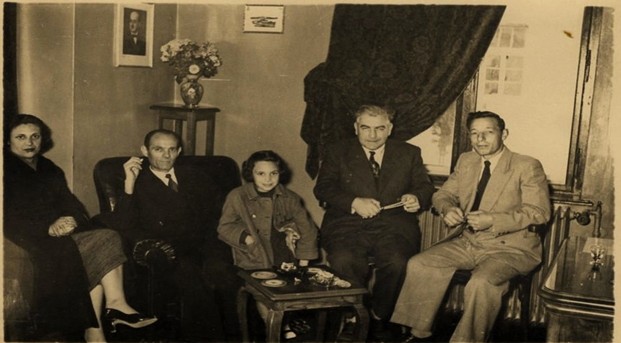
In the photograph given to me by the late Skamagkis appear his wife Sarita (Angeliki), their daughter, himself, the father of Konstantinos Tsigas, Ioannis, and Konstantinos Kyriakidis, father of my professor Menelaos Kyriakidis. The photograph of the Skamagkis family is kept in the Mayor’s Office at the Municipality of Kavala, on the side facing the Megali Leschi, from the period when the window there was open. On the wall, one can see a photograph of Mayor Athanasios Balanos. It dates from the time when Athanasios Vavaleskos had been elected mayor of the city.